Hybrid Magento and Symfony Architecture for a Physically-Backed Precious Metals Trading Platform
Introduction
Some commerce systems are closer to financial platforms than ordinary online stores.
A physically-backed precious metals trading platform is a good example. The customer is not simply buying a product, waiting for shipping, and receiving a package. The customer deposits funds, buys or sells fractional amounts of gold and silver, tracks portfolio value, reviews transaction history, and expects the numbers to remain precise and explainable.
The public product model is straightforward: deposit funds, buy or sell precious metals, and withdraw funds when needed. The public Trade page describes fractional buying from small amounts, 24/7 trading, direct ownership of physically allocated metals, portfolio tracking, trade history, insured storage, and one-to-one physical backing. That makes the engineering problem more interesting than a normal catalog checkout.
This article describes a generalized architecture pattern for that kind of system: a legacy Magento layer working alongside a modern PHP 8.3 Symfony backend, with gRPC services exposing trading endpoints.
It is intentionally written as a portfolio-safe technical article. It does not describe any private client system, proprietary codebase, internal module, file path, database schema, or confidential implementation detail. Code examples are representative and simplified; they show the engineering pattern, not copied production code.
Product Context
The product concept is digital trading of physically-backed gold and silver.
Customers can fund an account, buy or sell fractional metal quantities, and track their portfolio in a dashboard. Behind the scenes, the system needs to connect customer balances, metal holdings, live or near-real-time prices, locked quotes, transaction execution, and historical portfolio state.
That creates a few non-negotiable requirements:
- prices must be current enough for trading decisions
- quotes must be locked before execution
- buy and sell calculations must use explicit precision rules
- fees and premiums must be visible and reproducible
- portfolio state must update consistently after a transaction
- transaction history must be audit-friendly
- legacy screens and modern services must agree on the same business rules
This is where the architecture matters. A basic storefront can tolerate some eventual display inconsistency. A trading workflow cannot casually disagree about totals, quantities, fees, or holdings.
High-Level Architecture
The architecture is hybrid.
The legacy Magento layer remains responsible for customer-facing account flows, trade pages, cash/deposit screens, portfolio templates, history screens, and integration glue around existing customer and commerce data. This is a common reality in mature commerce systems: the legacy platform still owns important workflows and operational context.
The modern backend layer is built with PHP 8.3 and Symfony. It provides a cleaner service boundary around trading operations and exposes those operations through gRPC. That service layer handles requests such as current market quotes, locked quote creation, transaction posting, holdings, transaction history, and portfolio value history.
The important architectural decision is separation of responsibilities:
- Magento handles legacy storefront and account integration
- Symfony services handle modern API orchestration
- gRPC defines structured service contracts
- trading services handle quote, execution, and portfolio behavior
- shared validation protects customer eligibility and request correctness
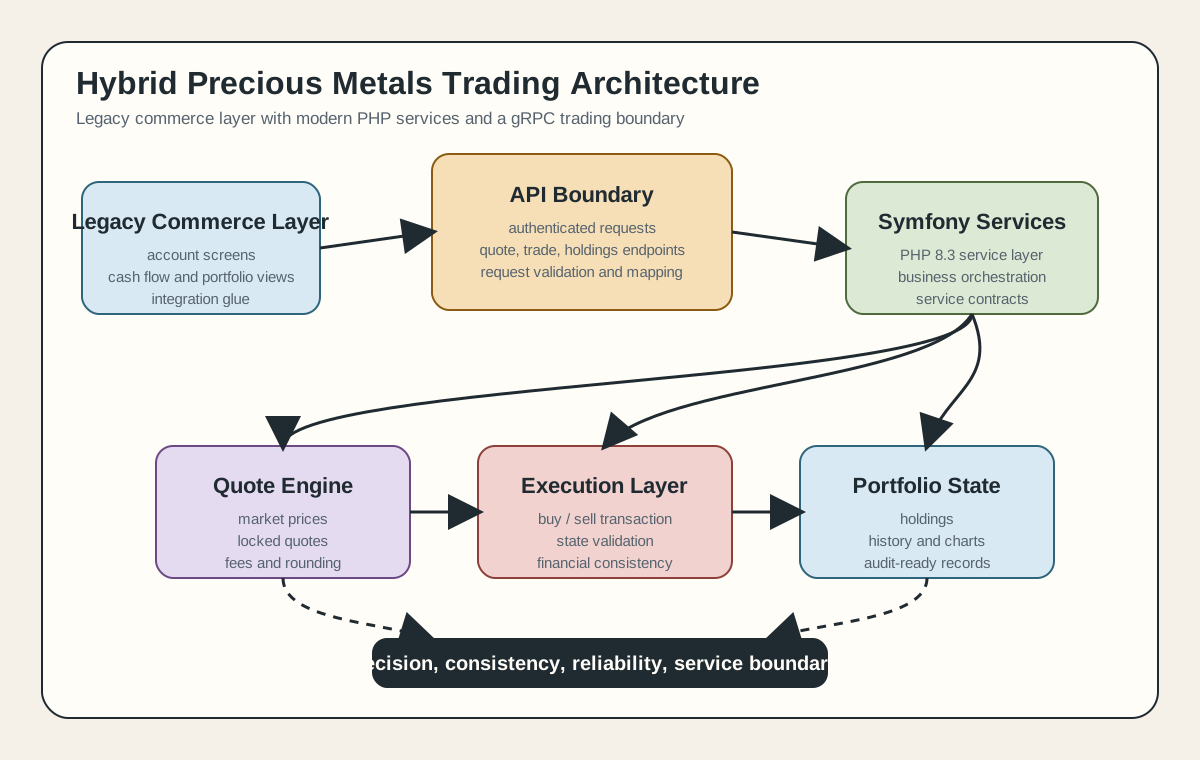
This is not a clean-room replacement of Magento. It is a staged modernization pattern. The system keeps the legacy layer where it still provides value, while moving API-facing trade functionality into a more explicit service boundary.
Trading Flow
The core user journey is simple from the outside.
First, the customer deposits funds into the trading account. Then they request a market quote for gold or silver in the selected currency. The system returns buy and sell pricing. If the customer chooses to proceed, the system creates a locked quote for a specific side, metal, amount, or quantity. Finally, the customer executes the transaction, and the portfolio state updates.
The backend flow is stricter:
- Validate that trading is enabled.
- Validate that the customer is allowed to trade.
- Retrieve market pricing for supported metals and currencies.
- Create a locked quote with a short validity window.
- Calculate quantity, subtotal, fee, and total using decimal math.
- Post the transaction from the locked quote.
- Update holdings, cash balance, transaction history, and portfolio views.
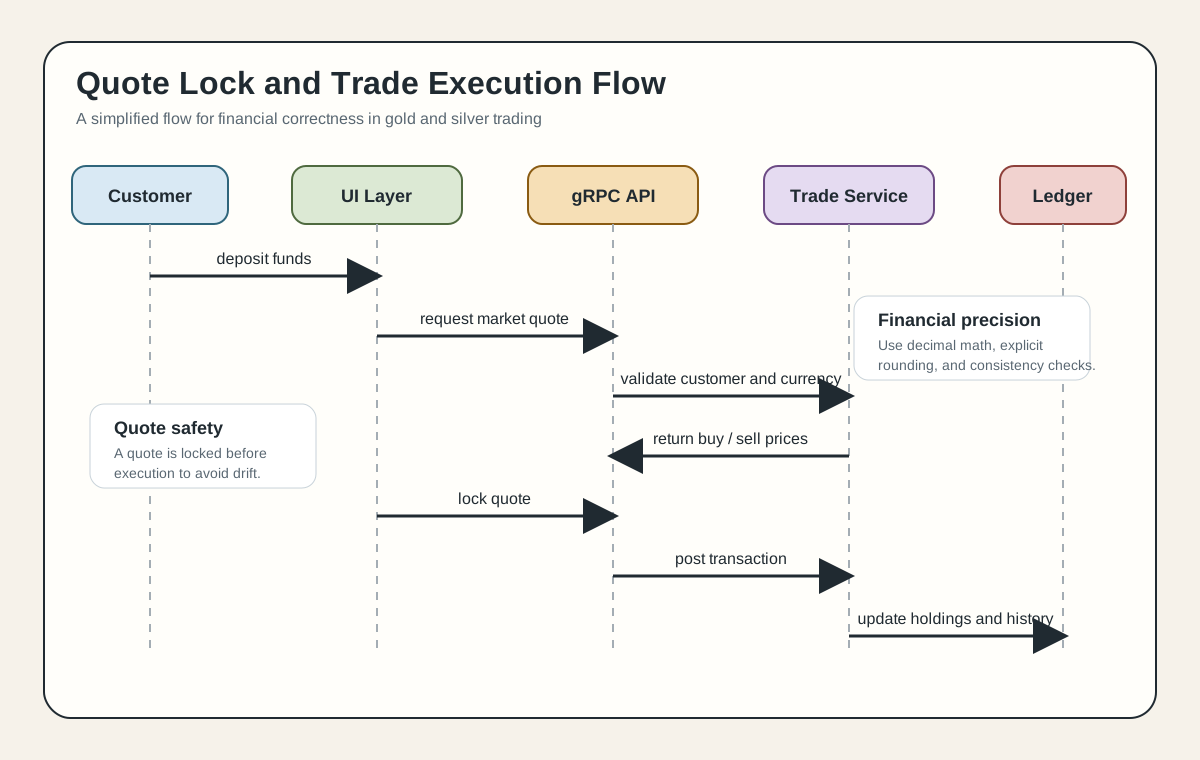
This quote-lock pattern is important. It prevents the UI from displaying one price while the backend executes another without a controlled transition. In a financial workflow, the customer needs to know what they accepted, and the backend needs a stable reference for execution.
gRPC Service Boundary
gRPC is useful here because trading operations are naturally contract-driven.
The platform needs clear request and response types for market quotes, locked quotes, post-transaction calls, holdings, and history. Those contracts create a useful boundary between the customer-facing layer and the backend trading services.
A simplified proto shape might look like this:
syntax = "proto3";

package trade;

service QuoteService {
  rpc GetMarketQuote (GetMarketQuoteRequest) returns (GetMarketQuoteResponse);
  rpc LockQuote (LockQuoteRequest) returns (LockQuoteResponse);
}

service TradingService {
  rpc PostTransaction (PostTransactionRequest) returns (PostTransactionResponse);
  rpc GetHoldings (GetHoldingsRequest) returns (GetHoldingsResponse);
}

message LockQuoteRequest {
  string currency = 1;
  string metal = 2;
  string side = 3;
  oneof input {
    string quantity = 4;
    string amount = 5;
  }
}
The exact schema will vary by platform, but the idea is stable: trading operations should be explicit, typed, validated, and versionable.
On the Symfony side, the service handler becomes an orchestration layer rather than a place to hide all business rules:
final class QuoteEndpoint
{
    public function __construct(
        private TradeEligibilityValidator $eligibility,
        private QuoteService $quotes,
        private ResponseMapper $mapper,
    ) {}

    public function lockQuote(LockQuoteRequest $request, AuthenticatedUser $user): LockQuoteResponse
    {
        $this->eligibility->assertCanTrade($user->customerId());

        $quote = $this->quotes->createLockedQuote(
            customerId: $user->customerId(),
            currency: $request->currency(),
            metal: $request->metal(),
            side: $request->side(),
            quantity: $request->quantity(),
            amount: $request->amount(),
        );

        return $this->mapper->lockedQuote($quote);
    }
}
This shape keeps the API boundary readable. The endpoint validates the request, confirms the customer is eligible to trade, delegates business behavior, and maps the result back to a transport response.
Financial Precision
The hardest part of this type of system is not the endpoint. It is correctness.
Gold and silver trading depends on quantities, spot prices, premiums, fees, subtotals, and final totals. Floating-point math is a poor fit for that. The system should use decimal-safe operations and explicit rounding rules.
Representative calculation logic might look like this:
final class TradeCalculator
{
    public function total(string $side, string $price, string $quantity, string $fee): string
    {
        $subtotal = bcmul($price, $quantity, 8);

        return match ($side) {
            'BUY' => $this->roundUp(bcadd($subtotal, $fee, 8), 2),
            'SELL' => $this->roundDown(bcsub($subtotal, $fee, 8), 2),
            default => throw new InvalidArgumentException('Unsupported trade side.'),
        };
    }

    private function roundUp(string $value, int $scale): string
    {
        // Representative implementation: use a shared decimal utility in production.
        return number_format(ceil((float) $value * 10 ** $scale) / 10 ** $scale, $scale, '.', '');
    }

    private function roundDown(string $value, int $scale): string
    {
        return number_format(floor((float) $value * 10 ** $scale) / 10 ** $scale, $scale, '.', '');
    }
}
In production, the rounding utility should avoid converting to float internally. The example is intentionally short, but the rule is the important part: buy and sell flows often require different rounding behavior, and that behavior must be centralized.
The backend should also re-check totals before execution. The UI can display an estimated total, but the backend must calculate the authoritative total from the current locked quote.
if (!$quote->matchesCustomer($customerId) || $quote->isExpired()) {
    throw new DomainException('Quote is no longer valid.');
}

$expectedTotal = $calculator->total(
    side: $quote->side(),
    price: $quote->tradePrice(),
    quantity: $quote->quantity(),
    fee: $quote->fee(),
);

if ($expectedTotal !== $quote->lockedTotal()) {
    throw new DomainException('Quote total failed consistency check.');
}
That is the kind of defensive logic that separates a trading system from a normal eCommerce customization.
Legacy Magento Integration
The Magento layer still matters.
It owns account context, customer session behavior, older templates, dashboard screens, payment entry points, transaction success pages, and parts of the operational workflow. In a hybrid system, the legacy layer often acts as the bridge between customer-facing commerce pages and newer backend services.
A representative Magento-side controller should stay thin:
final class TradeController extends BaseAccountController
{
    public function buyAction(): void
    {
        if (!$this->validateFormKey()) {
            $this->redirectWithError('Session expired. Please try again.');
            return;
        }

        try {
            $quoteId = $this->request->getParam('quote_id');
            $result = $this->tradeClient->postTransaction($quoteId);

            $this->session->addSuccess('Your balance has been updated.');
            $this->renderSuccessPage($result);
        } catch (Throwable $exception) {
            $this->logger->error('Trade execution failed.', ['exception' => $exception]);
            $this->redirectWithError('The trade could not be completed. Please refresh and try again.');
        }
    }
}
The goal is to keep legacy controllers from becoming the source of truth for trading. They should handle request flow, security checks, UI feedback, and service calls. Pricing, quote locking, execution, and portfolio state belong behind a service boundary.
Portfolio and History
The portfolio view is where the customer sees whether the system is trustworthy.
A strong portfolio screen should show metal allocation, current market value, average cost, current rates, recent buy/sell activity, and portfolio value over time. The backend needs to supply holdings and history in a way that is consistent with transaction execution.
This usually means separating:
- current holdings
- transaction history
- portfolio value history
- market quote history
- cash balance
- pending activity
The API shape should reflect that separation. Holdings are not the same thing as history. History is not the same thing as chart data. Chart data is a derived read model, not the transaction ledger itself.
That distinction makes the platform easier to reason about and easier to optimize.
Reliability and Boundaries
Hybrid architecture introduces risk if boundaries are unclear.
Magento and Symfony cannot each invent their own version of customer eligibility, rounding, quote expiration, or transaction execution. Those rules need a single authoritative home. The more financial the workflow becomes, the more dangerous duplicated logic becomes.
The most important engineering boundaries are:
- customer eligibility validation
- quote creation and quote expiration
- decimal math and rounding
- trade execution
- transaction persistence
- portfolio state updates
- error handling and logging
Modernizing this kind of platform is not just about using Symfony or gRPC. It is about deciding which layer owns which responsibility and then enforcing that decision consistently.
Senior Engineering Role
The senior role in this type of project is to connect the old and new parts of the system without breaking the trading flow.
That means understanding the Magento layer well enough to change it safely, while also building PHP services that expose clear API contracts. It also means treating financial data carefully: precision, rounding, validation, repeatable calculations, consistency checks, and safe execution flows.
The work includes:
- analyzing legacy trade, cash, portfolio, and history flows
- improving the separation between Magento and backend services
- shaping gRPC endpoints around real trading use cases
- validating customer eligibility and request correctness
- keeping financial calculations centralized and reproducible
- improving performance and reliability in quote and portfolio flows
- modernizing legacy functionality step by step
That is the practical value of the hybrid approach: the system can improve without pretending the legacy platform no longer exists.
Closing
A physically-backed precious metals trading platform is a useful example of real modernization work on a legacy commerce stack.
It combines legacy commerce, modern PHP services, gRPC APIs, financial calculations, portfolio state, and operational reliability. The hard part is not only building endpoints. The hard part is making sure every layer agrees on price, quantity, fee, total, eligibility, and portfolio state.
That kind of work combines Magento experience, Symfony service design, API integration, and careful handling of financial data.